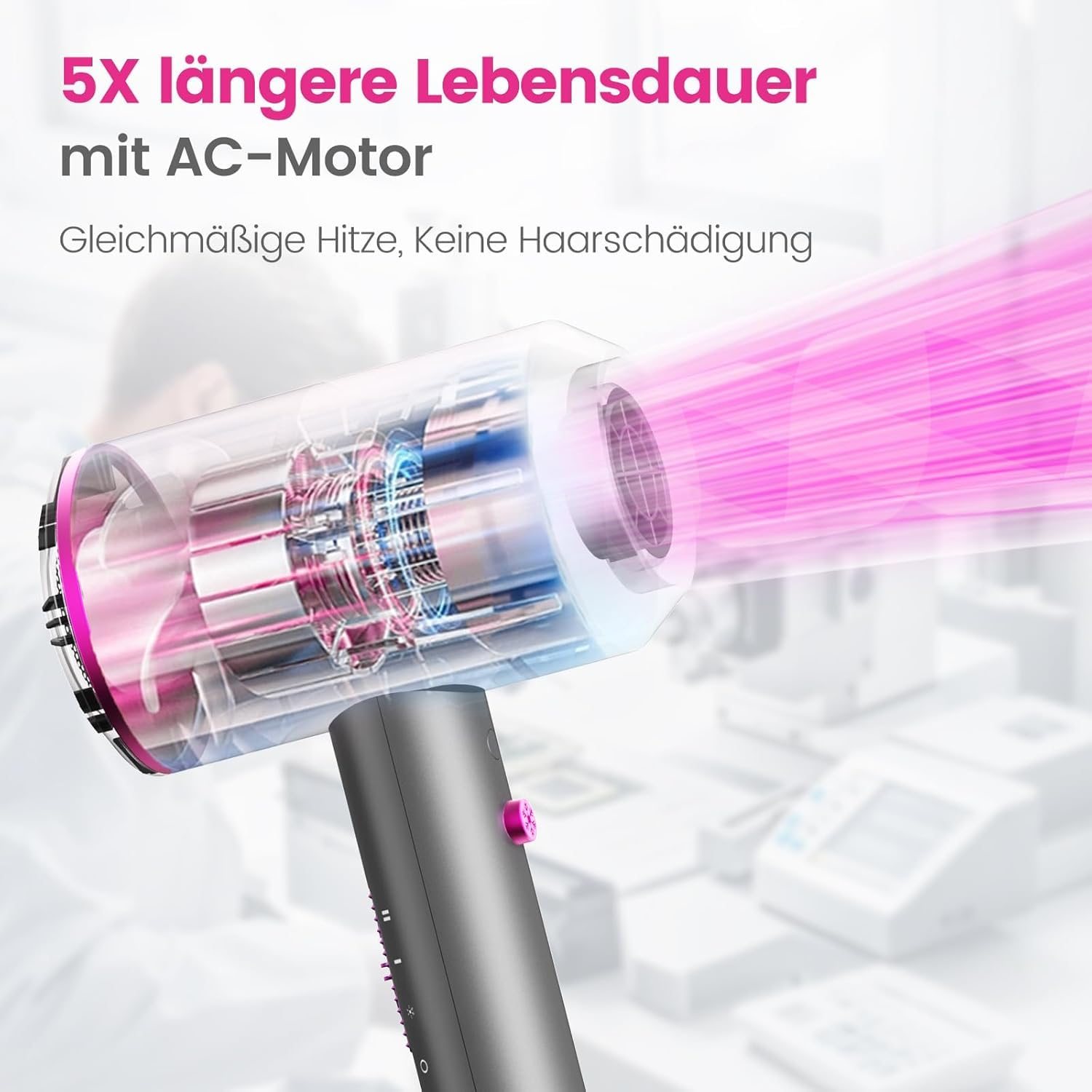
Technology
Anyone can build a dryer that blows hard. CASAMAA puts four systems into every model so that speed never has to be paid for in damaged hair — an AC motor, ionic conditioning, a measured ≈ 57 °C outlet, and a low-radiation build.
As air passes the ion generator, millions of negative ions neutralise the positive charge in wet hair. The cuticle lies flat, static disappears, and shine comes from the hair itself — not from a silicone film.
AC motors move more air per watt and are built to salon duty cycles. Where a standard DC dryer fades after months, a CASAMAA AC motor keeps its power curve year after year — roughly five times the service life.
A sensor at the outlet reads air temperature many times per second and throttles the heater to hold a constant ≈ 57 °C — hot enough to style, never hot enough to scorch the cuticle. Even heat means no surprise damage.
A low magnetic-wave motor structure keeps electromagnetic radiation well below that of conventional dryers, with automatic power-interruption protection and overheat cutoffs built in as standard.
The numbers

Hair damage from blow-drying comes from temperature spikes, not from a steady moderate temperature. A dryer that claims 100 °C but holds it unevenly pushes sections of hair past the 155–160 °C wet-hair threshold in bursts; a dryer that holds a measured 57 °C never approaches it. CASAMAA measures the outlet continuously and corrects it, so the temperature stays flat across a 10-minute session instead of climbing as the element heats up.
Ionic conditioning has a measurable, temporary effect: it neutralises static charge on the surface of the hair. It does not repair the cortex, add protein, or change hair structure. What it changes is how hair behaves immediately after drying — less flyaway, flatter cuticle, more reflected light. The effect lasts until the next wash. That is why the CASAMAA claim is limited to frizz and shine rather than repair, and why every model ships with the same generator rather than reserving it for a premium tier.
The motor and heater are arranged so the electromagnetic field around the housing stays well below the level of a conventional dryer at the same power. In practice this means a laminated motor structure and a shielded heating circuit rather than an open coil. Automatic power-interruption protection and overheat cut-offs are fitted as standard on every model, independent of the radiation design — the two systems are separate safety layers, not one feature described twice.
Published research puts the point where wet hair proteins may begin to denature at 155–160 °C, and at 235–250 °C on dry hair; hot styling tools above 200 °C cause measurable keratin damage. A dryer that holds the outlet at a constant ≈ 57 °C keeps a wide margin below all three numbers, and — more importantly — removes the temperature spikes that a cheap dryer produces every time it cycles its element on.
The AeroStyle 1500's optimised AC motor pushes a wide, dense air stream that dries up to 32% faster than a conventional dryer at the same gentle outlet temperature.
Yes. The motor uses a low magnetic-wave structure that keeps electromagnetic radiation well below the level of conventional dryers, and automatic power-interruption protection plus overheat cutoffs are built in as standard.
Roughly five times as long. DC motors rely on carbon brushes that physically wear against a spinning commutator; AC motors are induction-driven, so the power curve stays flat for years.
Temperature thresholds quoted on this page come from peer-reviewed literature, not from our own testing.